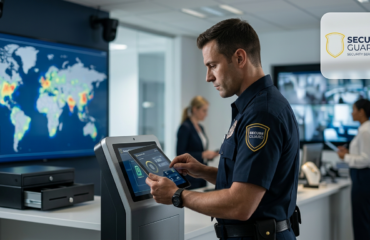
Bank security guards support a financial institution’s broader security program by helping manage access, observe activity, follow emergency procedures, document incidents, and communicate with bank management and first responders when appropriate.
Banks and credit unions can face security concerns involving robbery, unauthorized access, workplace violence, disruptive behavior, alarms, medical emergencies, fires, suspicious activity, and after-hours incidents. However, a security guard should not be expected to invent a response plan during an emergency.
Instead, officers should work from clearly defined procedures, post orders, training, and communication protocols established by the financial institution and security provider.
Federal regulations also recognize the importance of formal bank security planning. For example, FDIC-supervised institutions must maintain a written security program that addresses opening and closing procedures, protection of valuables, crime identification and evidence preservation, employee training, and appropriate security devices.
Financial institutions can review the current requirements in 12 CFR Part 326. Regulatory requirements vary by institution type and regulator, so banks should also consult their compliance and legal teams.
What Is the Role of Bank Security Guards?
Bank security guards provide physical-security support according to the institution’s approved procedures and the responsibilities assigned to their post.
Depending on the branch or financial facility, officers may support:
- Entrance and lobby observation
- Visitor management
- Employee access procedures
- Restricted-area control
- Parking-area patrols
- Opening or closing security procedures
- Alarm and surveillance observation
- Incident documentation
- Emergency communication
- Coordination with bank management and first responders
The U.S. Bureau of Labor Statistics identifies common security guard duties such as controlling access, patrolling property, monitoring alarms and surveillance systems, responding to emergencies, conducting security checks, and writing reports.
Review the U.S. Bureau of Labor Statistics security guard profile for additional information.
Bank Security Starts With a Written Security Program
A professional bank security program should exist before an emergency occurs.
For FDIC-supervised institutions, federal regulations require the board of directors to ensure that a written security program is developed and implemented. A designated security officer administers that program.
The required program includes procedures for:
- Opening and closing the banking office
- Safeguarding currency and other valuables
- Helping identify people who commit crimes against the institution
- Preserving evidence
- Training officers and employees
- Selecting and maintaining appropriate security devices
That distinction is important.
Security guards may help carry out the bank’s approved procedures, but they should not independently create regulatory security policies or make management-level decisions outside their assigned authority.
1. Access Control and Lobby Security
Financial institutions are public-facing environments, but not every part of a bank should be open to every visitor.
Depending on the location, security officers may support:
- Lobby observation
- Visitor procedures
- Employee entrances
- Restricted offices
- After-hours access
- Vendor and contractor entry
- Parking-area observation
Access rules should come from the institution’s written procedures and post orders.
Secure Guard provides armed and unarmed security officers for properties that require professional access control, patrols, observation, and incident reporting.
2. Bank Security Guards Should Follow Established Emergency Procedures
Emergencies can develop quickly, so officers need clear instructions before an incident occurs.
Post orders and emergency procedures may explain:
- Who should be notified
- When emergency services should be contacted
- Which areas should be secured
- How visitors should be directed
- Who communicates with management
- What information must be documented
The purpose of these procedures is consistency.
An officer should not have to guess who to call or what the bank expects during a serious incident.
3. Robbery and Burglary Preparedness Requires Training
Robbery and burglary are specific concerns addressed by federal bank-security rules.
For FDIC-supervised institutions, the security program must include procedures that help identify people committing crimes against the bank and preserve evidence that may assist identification and prosecution.
The same rules also require initial and periodic training of officers and employees regarding their responsibilities under the security program and appropriate conduct during and after robberies, burglaries, or larcenies.
During an actual incident, security personnel should follow the bank’s approved procedures and avoid taking actions outside their training or assigned authority.
The FBI investigates bank robbery and works with state and local law-enforcement partners. Financial institutions can review the FBI bank robbery resource for additional information.
4. Security Officers Can Support Workplace Violence Procedures
Banks and other financial institutions involve regular interaction with the public and the handling of money, both of which can contribute to workplace-violence risk.
OSHA identifies factors such as exchanging money with the public, working alone, working in isolated areas, and operating during late hours as conditions that may increase workplace-violence risk.
Review the OSHA workplace violence guidance for additional information.
Depending on the institution’s policies and officer training, bank security guards may support workplace-violence procedures by:
- Observing concerning behavior
- Notifying appropriate personnel
- Maintaining professional communication
- Following approved de-escalation procedures
- Separating uninvolved visitors when appropriate
- Contacting law enforcement when required
- Documenting the incident
Private security should be one part of a broader workplace-violence prevention plan rather than the institution’s only safeguard.
5. Security Guards Can Support Fire, Medical, and Evacuation Procedures
Financial institutions may also face emergencies unrelated to crime.
These may include:
- Medical emergencies
- Fire alarms
- Utility failures
- Severe weather
- Evacuations
- Building-system alarms
Security officers may help communicate with staff, maintain access routes, direct visitors, secure affected areas, and contact first responders according to the bank’s approved procedures.
However, security personnel do not replace firefighters, emergency medical professionals, police officers, or bank management.
Their responsibilities should match their training and assigned post orders.
6. Video Surveillance Supports Bank Security and Documentation
Video surveillance is an important component of many financial-institution security programs.
For FDIC-supervised banks, federal rules identify camera systems as one example of a security measure that may assist in identifying people who commit crimes against the institution.
Camera coverage may support:
- Lobby observation
- Entrances and exits
- Parking areas
- Restricted areas
- Incident documentation
Secure Guard’s video monitoring services can support camera observation, activity verification, communication, and client-approved escalation procedures where appropriate.
Recorded footage and monitoring procedures should follow the bank’s legal, regulatory, privacy, retention, and internal-policy requirements.
7. Communication During an Incident Should Follow a Defined Chain
Clear communication can reduce confusion during an emergency.
Before service begins, a financial institution should define who security personnel contact during different types of incidents.
The communication chain may involve:
- Branch management
- Bank security management
- Security supervisors
- Emergency services
- Law enforcement
- Facilities personnel
Security guards should provide accurate operational information to the people identified in their procedures.
Unless specifically assigned and trained for that role, officers should not independently act as media spokespeople, publish incident updates, or create public crisis messaging.
External communication should remain with the individuals designated by the financial institution.
8. Training and Exercises Help Identify Gaps
Written procedures are more useful when employees and security personnel understand them.
Training may review:
- Emergency contacts
- Alarm procedures
- Access-control rules
- Robbery procedures
- Evacuation routes
- Incident reporting
- Communication responsibilities
Financial institutions may also conduct drills, tabletop exercises, or other training activities based on their policies and regulatory requirements.
After an exercise, management can identify unclear instructions, communication gaps, or procedures that need revision.
Security personnel should participate only in exercises and responsibilities that match their role and training.
9. Incident Reporting Is Part of Emergency Response
An emergency does not end when the immediate situation is over.
Management may need accurate records covering:
- Date and time
- Location
- People involved
- What officers observed
- Actions taken
- Who was notified
- Property damage
- Law-enforcement involvement
- Follow-up requirements
Secure Guard uses SecureTrack security reporting and patrol verification to support incident reports, digital activity records, GPS-backed patrol checkpoints, photographs, and post orders depending on the client’s service configuration.
For more guidance on documentation, read Secure Guard’s article on security reporting and communication.
10. Post-Incident Review Should Be Led by Management
After a serious incident, bank management and the designated security leadership may review what happened and determine whether procedures need to change.
The review may examine:
- Access-control procedures
- Alarm performance
- Camera coverage
- Communication
- Officer response
- Employee training
- Post orders
- Physical-security equipment
Security guards can provide reports and observations, but management should lead decisions about policy changes, regulatory reporting, recovery, and future security strategy.
Armed vs. Unarmed Bank Security Guards
Not every bank or financial institution requires armed security.
Unarmed officers may be appropriate where the primary responsibilities involve:
- Lobby observation
- Access control
- Visitor assistance
- Parking patrols
- Incident documentation
Armed officers may be considered when a documented risk assessment identifies higher-risk conditions, valuable assets, serious threats, or other circumstances that justify armed coverage.
The decision should account for:
- Risk level
- Location
- Public interaction
- Previous incidents
- Bank policy
- Insurance requirements
- Applicable state licensing requirements
Read Secure Guard’s guide to armed vs. unarmed security for a broader comparison.
Bank Security Should Use Multiple Layers
A security guard should not be the bank’s only protective measure.
A layered physical-security program may include:
- Security officers
- Alarm systems
- Security cameras
- Access-control procedures
- Vaults and secure storage
- Exterior locks
- Lighting
- Incident reporting
- Employee training
Federal banking rules also recognize the importance of multiple security devices and procedures rather than relying on one safeguard.
The correct combination should reflect the institution’s risk profile and regulatory requirements.
24/7 Security Support May Be Useful for Some Financial Properties
Some financial institutions operate beyond normal lobby hours or maintain offices, operations centers, ATM areas, parking structures, or other facilities that require additional after-hours coverage.
Depending on the property, a broader security program may combine:
- On-site officers
- Mobile patrols
- Video monitoring
- Dispatch support
- Digital reporting
Read our guide to 24/7 security support services for more information about after-hours security planning.
Questions Banks Should Ask a Security Company
Before selecting a security provider, financial institutions should ask:
- Are the assigned officers properly licensed?
- Do you have experience with financial or high-value properties?
- How will officers be trained on our procedures?
- How are post orders created?
- How are officers supervised?
- How are call-offs handled?
- What reports will management receive?
- Can patrol completion be verified?
- Can officers work with our camera and access-control systems?
- How are emergencies escalated?
The provider should explain how its personnel fit into the bank’s existing security program rather than presenting private guards as a replacement for bank security management or law enforcement.
Build Bank Security Around Established Procedures
Effective emergency preparedness requires planning before an incident occurs.
Bank security guards can support that plan through access control, patrols, observation, communication, incident reporting, and approved emergency procedures.
However, security personnel should work within the financial institution’s established security program, management structure, regulatory requirements, and response plans.
Secure Guard Security Services provides professional security personnel, mobile patrols, video monitoring, post orders, field supervision, dispatch support, and SecureTrack reporting for properties that require structured physical-security coverage.
Explore our complete range of professional security services.
To discuss security coverage for a financial property, call 888-908-7818 or request a security consultation with Secure Guard.