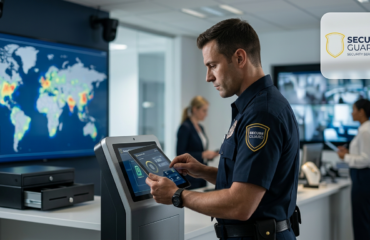
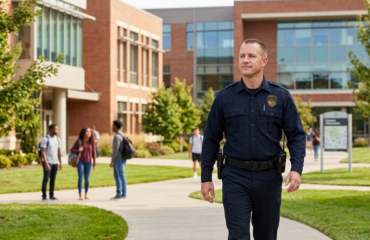
Security guard company services can include much more than placing one officer at an entrance. Depending on the property, a professional security program may combine on-site officers, mobile patrols, access control, video monitoring, event security, surveillance technology, reporting, and field supervision.
The right service mix depends on the property’s layout, operating hours, access points, visitor activity, previous incidents, assets, and existing security systems.
The U.S. Bureau of Labor Statistics identifies common security guard duties such as controlling building access, patrolling property, monitoring alarms and video-surveillance systems, conducting security checks, responding to emergencies, and writing reports.
Businesses can review the U.S. Bureau of Labor Statistics security guard profile for additional information.
Here are eight essential services businesses and property managers may encounter when comparing professional security companies.
1. Armed and Unarmed Security Officers
On-site security officers are one of the most common services offered by professional security companies.
Depending on the property, officers may support:
- Lobby and entrance security
- Visitor management
- Employee credential checks
- Gate procedures
- Foot patrols
- Parking-area observation
- Restricted-area control
- Incident documentation
- Emergency communication
However, not every property requires the same type of officer.
Unarmed Security Officers
Unarmed officers may be appropriate for properties where the primary needs involve access control, patrols, customer interaction, visitor procedures, and reporting.
Common environments may include:
- Corporate offices
- Apartment communities
- Hotels
- Retail properties
- Healthcare facilities
- Business parks
Armed Security Officers
Armed officers may be considered when a property has documented higher-risk conditions, sensitive operations, valuable assets, serious prior incidents, or specific contractual requirements.
The choice between armed and unarmed coverage should follow a site-specific risk assessment rather than a generic industry rule.
Secure Guard provides armed and unarmed security officer services based on the property’s operating environment and risk profile.
2. Mobile Patrol Services
Some properties need security coverage across a wider footprint but do not require an officer at one fixed post throughout the entire shift.
Mobile patrol services can provide scheduled or randomized checks across:
- Parking lots
- Parking garages
- Building perimeters
- Warehouses
- Business parks
- Apartment communities
- Construction sites
- Equipment yards
- Multi-building properties
Patrol duties may include checking doors and gates, inspecting exterior areas, observing parking activity, documenting property conditions, and reporting unusual activity.
For best results, patrol routes should use clear checkpoints, reporting standards, and escalation procedures rather than undocumented drive-through visits.
3. Access Control and Visitor Management
Controlling who enters a property is one of the most important parts of many security programs.
Security officers may support:
- Employee badge verification
- Visitor registration
- Vendor check-in
- Contractor access
- Vehicle-entry procedures
- Temporary visitor passes
- Restricted-area control
- After-hours access procedures
Property management should define who may enter, which credentials are acceptable, what information officers must record, and when management should be contacted.
These expectations should appear in the site’s written post orders so officers can apply them consistently.
4. Video Monitoring Services
Security cameras can provide broad visibility across entrances, parking areas, loading zones, common areas, warehouses, and property perimeters.
However, recorded footage alone does not always provide active oversight.
Secure Guard’s video monitoring services can support camera observation, activity verification, communication, documentation, and client-approved escalation procedures.
Depending on the property and existing equipment, monitoring may support:
- Entrance observation
- Parking-area monitoring
- Loading-dock visibility
- Perimeter observation
- After-hours activity verification
- Communication with on-site officers
- Mobile patrol coordination
Video monitoring is often most useful when it works alongside clear procedures and professional personnel.
5. Event Security Services
Events create temporary security conditions that can differ significantly from a property’s normal operations.
Security personnel may support:
- Entry procedures
- Credential checks
- Guest flow
- Restricted-area control
- Vendor access
- Crowd observation
- Parking support
- Incident documentation
- Emergency communication
Secure Guard provides event security officers for corporate functions, private events, community gatherings, and other approved venues.
The appropriate staffing level should depend on attendance, venue layout, access points, restricted areas, event schedule, and documented security concerns.
6. Construction Site and Outdoor Property Security
Construction sites, equipment yards, vacant properties, and outdoor facilities often have large perimeters and valuable materials or equipment.
A security program may combine:
- Fixed security posts
- Contractor and delivery access
- Mobile patrols
- Fence-line checks
- Equipment-area patrols
- After-hours inspections
- Video monitoring
For properties that need flexible outdoor camera coverage, mobile surveillance towers may provide additional visibility around entrances, equipment areas, parking lots, and perimeter zones.
Rather than relying on broad claims about construction theft, property managers should assess the actual value of equipment, site access, operating hours, lighting, fencing, and previous incidents.
7. Plain-Clothes and Loss-Prevention Support
Some retail and commercial environments may benefit from security personnel who work without a traditional uniform.
Plain-clothes officers may support:
- Discreet observation
- Loss-prevention programs
- Pattern identification
- Incident documentation
- Coordination with store management
Secure Guard’s plain clothes security officers can support approved retail and commercial security programs.
Security companies should clearly define what plain-clothes personnel are authorized to do and how incidents should be escalated.
8. Reporting, Patrol Verification, and Supervision
A professional security program should provide more than a guard physically standing at a post.
Property managers also need visibility into what occurred during each shift.
Reporting may include:
- Daily activity reports
- Incident reports
- Patrol checkpoints
- Photographs
- Visitor or vehicle records
- Property-condition observations
- Supervisor notes
- Follow-up requirements
Secure Guard uses SecureTrack security reporting and patrol verification to support GPS-backed patrol records, incident reports, photographs, checkpoints, and post orders depending on the client’s service configuration.
Field supervision also helps confirm that officers follow post orders, complete assigned patrols, maintain professional standards, and communicate issues appropriately.
Other Specialized Security Services
Some security companies also provide specialized services depending on licensing, staffing, location, and assignment requirements.
These may include:
- Executive protection
- Traffic control support
- Fire Watch
- Alarm-response coordination
- Temporary security coverage
For example, Secure Guard provides executive protection services for assignments requiring specialized protective planning.
Businesses should confirm that the provider has the licensing, training, personnel, and authority required for any specialized service before adding it to the security program.
California Security Guard Companies Must Meet Licensing Requirements
Businesses should verify that their security provider and assigned guards meet applicable state requirements.
In California, contract security businesses are generally regulated as Private Patrol Operators by the Bureau of Security and Investigative Services.
California BSIS also regulates individual security guard registrations.
Businesses can review the California BSIS Private Patrol Operator requirements and the BSIS Security Guard Registration requirements.
BSIS currently requires registered guards to complete applicable background checks, initial training, 32 hours of security-officer skills training within the required post-registration period, and annual continuing training.
How to Decide Which Security Guard Company Services You Need
Not every property needs every available service.
Before selecting coverage, review:
- Property layout
- Operating hours
- Entrances and exits
- Parking areas
- Visitor activity
- Vendor and delivery schedules
- Restricted areas
- Previous incidents
- Existing cameras and alarms
- High-value assets
For example, a business office may need one unarmed lobby officer and parking patrols. A warehouse may need gate security, truck verification, perimeter patrols, and monitoring. A construction project may need mobile patrols and surveillance towers.
The purpose of an assessment is to match security coverage to the property rather than automatically selecting the largest service package.
Security Guard Companies Should Use a Layered Approach
Physical security usually works best when several protective measures support one another.
A layered program may combine:
- Security officers
- Mobile patrols
- Access control
- Video monitoring
- Lighting
- Fencing and gates
- Alarm systems
- Reporting procedures
CISA’s Security Assessment at First Entry program uses a similar risk-based approach by reviewing existing safeguards, identifying vulnerabilities, and presenting mitigation options to facility owners.
Businesses can review the CISA SAFE physical-security assessment resource for additional information.
Questions to Ask a Security Guard Company
Before selecting a provider, ask:
- Is your security-company license current?
- Are assigned officers properly registered?
- How will you assess our property?
- How are post orders created?
- How are officers supervised?
- How are officer call-offs handled?
- What reports will management receive?
- Can patrol completion be verified?
- Can officers work with our existing cameras and access systems?
- How are serious incidents escalated?
For additional guidance, read Secure Guard’s article on how to choose business security services.
Choose Services That Match Your Property
The right security guard company services depend on what the property actually needs.
A professional provider should be able to explain why it recommends on-site officers, patrols, monitoring, access procedures, or other services rather than simply presenting the same package to every client.
Secure Guard Security Services provides professional security officers, mobile patrols, video monitoring, surveillance towers, event security, plain-clothes officers, executive protection, field supervision, post orders, and SecureTrack reporting.
Explore our complete range of professional security services.
To discuss security coverage for your property, call 888-908-7818 or request a security consultation with Secure Guard.