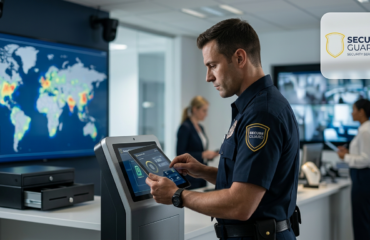
Knowing how to choose business security services can be difficult when every provider appears to offer similar guards, patrols, cameras, and security packages.
The right choice should not come down to the lowest hourly rate or the longest service list. Instead, a professional security provider should understand how your property operates, identify areas that need attention, explain how supervisors manage officers, and provide clear records of security activity.
First, businesses should understand their own risks before comparing security companies. The Cybersecurity and Infrastructure Security Agency uses a similar approach through its Security Assessment at First Entry program. This program reviews existing security measures, identifies vulnerabilities, and provides options for improvement.
Businesses can review the CISA Security Assessment at First Entry program for additional physical-security planning guidance.
Here are eight factors to compare when choosing business security services for your property.
1. Start With Your Property’s Actual Security Needs
Before requesting proposals, identify what you need the security program to accomplish.
Review:
- Property size and layout
- Entrances and exits
- Parking areas
- Employee activity
- Visitor traffic
- Vendor and delivery schedules
- Restricted areas
- Operating hours
- Previous incidents
- Existing cameras and alarms
- High-value assets
For example, a warehouse may need gate procedures, truck verification, perimeter patrols, and after-hours coverage. Meanwhile, an office building may focus more heavily on lobby security, visitor management, and parking patrols.
Understanding these differences makes it easier to compare proposals accurately.
For a broader overview of available security options, read Secure Guard’s Complete Guide to Business Security Solutions.
2. Verify the Security Company’s License
Next, verify the security provider’s licensing before comparing its services.
In California, the Bureau of Security and Investigative Services regulates companies that provide contract security services as Private Patrol Operators.
BSIS states that no person may engage in the business of a Private Patrol Operator in California without the appropriate license unless an exemption applies.
Before signing a contract, ask:
- What is your Private Patrol Operator license number?
- Is the license currently active?
- Are assigned guards properly registered?
- How do you verify officer credentials?
- How do you verify armed permits when armed coverage is required?
Review the California BSIS Private Patrol Operator Fact Sheet for current licensing information.
California guard-registration requirements are available through the BSIS Security Guard Registration Fact Sheet.
3. Compare the Types of Security Coverage Offered
In addition, compare the actual services each company can provide.
Not every provider offers the same operational capabilities.
Depending on your property, you may need:
- Armed or unarmed security officers
- Fixed security posts
- Mobile patrols
- Access-control support
- Event security
- Video monitoring
- Surveillance towers
- Incident reporting
- Patrol verification
The important question is not how many services a company lists. Instead, ask whether the provider can explain why a particular service fits your property.
Secure Guard provides armed and unarmed security officers for properties that need professional on-site coverage.
For larger properties, mobile patrol services can provide scheduled or randomized checks across parking areas, perimeters, warehouses, apartment communities, and multi-building locations.
4. Ask How Officers Are Selected and Trained
A security program depends heavily on the people assigned to the property.
Ask the provider how it handles:
- Officer screening
- License verification
- Site assignment
- Orientation
- Post orders
- Continuing training
- Performance problems
California BSIS requires security guards to meet registration, background-check, and training requirements. However, property-specific preparation also matters.
For example, an officer assigned to a warehouse should understand gate procedures, truck activity, and loading areas. By contrast, an officer assigned to an apartment community may need to understand guest access, parking, and amenity patrols.
Ask how the provider prepares officers for your specific environment instead of relying only on general guard training.
5. Evaluate Supervision and Replacement Staffing
However, officer qualifications are only part of the equation.
One of the most important differences between security companies is what happens after the officer arrives at the site.
Ask:
- Who supervises the assigned officers?
- How often do supervisors visit the property?
- How does the company identify missed patrols?
- What happens when an officer calls off?
- Who handles client complaints?
- How does management correct performance issues?
A security provider should have a clear management structure behind the officer.
Otherwise, property managers may find themselves responsible for tracking attendance, chasing reports, or repeatedly explaining site procedures to new guards.
6. Review Reporting and Patrol Verification
Furthermore, strong reporting should give clients clear visibility into each shift.
Professional reporting may include:
- Daily activity reports
- Incident reports
- Patrol checkpoints
- Photographs
- Visitor or vehicle records
- Property-condition concerns
- Supervisor notes
- Follow-up requirements
Ask potential providers to show you an example of their reporting process.
Secure Guard uses SecureTrack security reporting and patrol verification to support GPS-backed patrol records, incident reports, photographs, checkpoints, and post orders depending on the client’s service configuration.
As a result, clear reporting makes it easier for property managers to confirm that security duties are being completed and identify recurring concerns.
7. Evaluate Technology Based on What It Actually Does
At the same time, technology can strengthen a well-managed security program.
However, marketing terms should not replace clear explanations.
Useful physical-security technology may include:
- Security cameras
- Video monitoring
- Access-control systems
- Alarm systems
- GPS-supported patrol verification
- Digital incident reporting
- Mobile surveillance towers
Ask the provider:
- What does the technology actually monitor?
- Who reviews alerts?
- Can it work with our existing systems?
- How does the system document activity?
- What does the team do when it detects suspicious activity?
Secure Guard’s video monitoring services can support camera observation, activity verification, communication, documentation, and client-approved escalation procedures.
For larger outdoor properties, mobile surveillance towers may provide additional visibility in areas where permanent camera infrastructure is limited.
8. Compare the Entire Proposal, Not Just the Hourly Rate
Finally, compare the entire proposal rather than focusing only on the hourly rate.
Two proposals may appear similar while providing very different levels of:
- Supervision
- Officer training
- Replacement staffing
- Technology
- Reporting
- Dispatch support
- Management involvement
Before comparing pricing, confirm that each provider is proposing the same scope of work.
Ask:
- How many officers are included?
- Which hours are covered?
- Does the proposal include supervisor visits?
- Is patrol verification included?
- What technology is included?
- Are there additional fees?
- How does the company handle holidays and overtime?
The goal is to understand exactly what you are purchasing.
Questions to Ask Before Choosing Business Security Services
Use this checklist when interviewing potential providers:
- Is your security-company license current?
- Can you provide proof of insurance?
- How do you verify officer credentials?
- Have you worked with properties similar to ours?
- Who creates the post orders?
- Who supervises the officers?
- How do you handle call-offs?
- What reports will management receive?
- Can management verify patrol activity?
- Can you work with our existing cameras and access systems?
- How does your team escalate serious incidents?
- Can you provide relevant references?
Secure Guard’s guide to evaluating security company reputation provides additional guidance on reviews, credentials, supervision, and references.
Look for Experience Relevant to Your Industry
In addition, look for experience that matches your specific industry and property type.
A provider’s total years in business matter less if the company has no relevant experience with your type of property.
Commercial Offices
Security may focus on lobby coverage, visitor registration, employee access, parking patrols, and after-hours procedures.
Warehouses and Logistics Facilities
Security may focus on gates, truck verification, loading areas, perimeter patrols, and overnight operations.
Retail Properties
Security may focus on visible deterrence, parking areas, loss-prevention support, customer assistance, and incident reporting.
Construction Sites
Security may involve equipment protection, contractor access, mobile patrols, surveillance towers, and perimeter checks.
Apartment Communities
Security may involve guest access, parking, amenity patrols, gates, and property-management reporting.
Ask the provider how its procedures change for your type of property.
Watch for Common Security Company Red Flags
Potential warning signs include:
- Licensing information the company cannot verify
- Unclear insurance documentation
- No written post orders
- No clear supervisory structure
- No patrol-verification system
- Vague reporting procedures
- Pressure to sign before a property assessment
- Promises that sound impossible to verify
One issue does not automatically mean a provider is unsuitable. However, businesses should ask questions and compare the answers before committing to a contract.
Do Not Confuse Physical Security With Cybersecurity
Another important distinction involves physical security and cybersecurity.
Secure Guard’s services focus on physical security, including:
- Security officers
- Mobile patrols
- Video monitoring
- Surveillance towers
- Access procedures
- Dispatch support
- Security reporting
Businesses that need services such as network security, penetration testing, encryption, malware protection, or cybersecurity monitoring should work with qualified cybersecurity professionals.
This distinction helps businesses understand exactly what a provider is responsible for.
Choose a Provider That Can Explain the Security Program
Ultimately, the best way to choose business security services is to look beyond the service list.
A professional provider should be able to explain:
- What risks it identified
- Why it recommends specific coverage
- What officers will do
- How supervisors will manage the guards
- How the company will report incidents
- How management can verify patrols
- How the program can change when conditions change
Secure Guard Security Services has served clients since 2005 and provides physical-security programs using on-site officers, mobile patrols, video monitoring, surveillance technology, field supervision, post orders, and SecureTrack reporting.
Explore our full range of professional security services.
To discuss the right security program for your business, call 888-908-7818 or request a security consultation with Secure Guard.