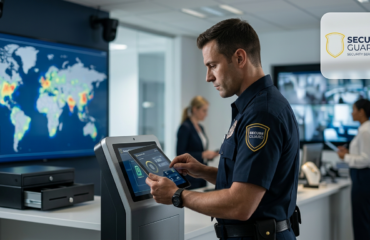
Artificial intelligence is changing how physical security teams monitor properties, review alerts, and organize information. However, AI does not eliminate the need for trained security officers. Instead, it can help security professionals focus their attention on activity that may require human review.
For businesses, property managers, and facility operators, the most practical question is not whether AI will replace security guards. The better question is how AI in security guard services can support officers, monitoring personnel, patrol teams, and security managers.
When technology and trained personnel work together, organizations can build a more informed and coordinated security program.
What Does AI Mean in Security Guard Services?
In physical security, artificial intelligence generally refers to software that can analyze information and identify predefined patterns or events. For example, an AI-assisted camera system may flag movement in a restricted area or identify a vehicle entering a property after normal business hours.
However, an alert is not the same as a confirmed security incident. A trained person still needs to review the situation, understand the context, and follow the property’s approved response procedures.
Therefore, AI works best as another layer within a broader security program that may include on-site security officers, mobile patrol services, cameras, access procedures, dispatch support, and incident reporting.
6 Practical Ways AI Can Support Physical Security
1. AI-Assisted Video Analytics
One of the most common applications of AI in physical security is video analytics. Traditional cameras record activity. By contrast, modern analytics can help identify certain events within a camera’s field of view.
Depending on the equipment and configuration, analytics may help flag:
- Movement in restricted areas
- After-hours activity
- People or vehicles crossing defined boundaries
- Loitering within selected zones
- Vehicles entering or leaving monitored areas
- Activity near gates, doors, loading areas, or perimeters
The system can then send an alert for review. A trained operator can examine the live or recorded footage and determine whether the activity requires further action.
This approach can complement professional video monitoring services by helping monitoring personnel prioritize camera activity instead of treating every movement as equally important.
2. Faster Alert Prioritization
A large property may have dozens of cameras and multiple areas that require attention. As a result, monitoring every video feed with the same level of attention can be difficult.
AI-assisted systems can help organize alerts based on predefined rules. For example, movement inside an employee parking lot at noon may be routine. The same movement near a secured gate at 2:00 a.m. may deserve closer review.
Importantly, the technology should support the operator rather than make every response decision automatically. Human review provides context that software may not have.
3. Supporting Remote and Temporary Security Sites
AI-assisted cameras can also be useful at properties where permanent security infrastructure is limited. Construction projects, storage yards, parking areas, vacant properties, and temporary work sites are examples.
In these settings, a mobile surveillance tower can provide elevated camera coverage and support remote monitoring. Smart alerts can help direct attention to activity in selected areas or during specific hours.
Once an alert occurs, monitoring personnel can review the situation and follow the site’s approved escalation procedures. Depending on the security plan, that may include documenting the activity, contacting a designated representative, coordinating with patrol personnel, or escalating a verified emergency when appropriate.
4. Helping Mobile Patrol Teams Use Information More Effectively
Mobile patrol officers often cover several areas during a shift. Therefore, information from cameras, dispatch, incident reports, or other security systems can help supervisors determine where attention may be needed.
For example, an unusual after-hours camera alert may lead to an additional patrol check. Likewise, repeated incidents around the same gate or parking area may show that the security plan needs adjustment.
Technology does not replace the patrol officer. Instead, it can provide additional information that helps the officer approach the property with better situational awareness.
Learn more about mobile patrol security services and how documented patrols can fit into a larger security program.
5. Reviewing Security Trends and Incident Data
Security programs generate information over time. This may include daily activity reports, patrol records, incident reports, camera alerts, access activity, and supervisor observations.
Software can help organize this information and make patterns easier to identify. For example, security managers may notice:
- Repeated activity in one part of a property
- Recurring incidents during certain hours
- Locations that require additional patrol attention
- Changes in access patterns
- Areas where post orders may need revision
However, data should be interpreted carefully. A pattern in historical information does not automatically predict what will happen next.
Secure Guard also uses SecureTrack to support digital security reporting and operational visibility. SecureTrack should be viewed as an accountability and reporting platform rather than a substitute for officer judgment.
6. Connecting Technology With Human Response
The strongest technology is useful only when there is a clear process for responding to the information it produces.
A practical AI-supported security workflow may look like this:
- Detect: A camera or security system identifies activity that matches a configured rule.
- Review: A trained person reviews the alert and available information.
- Assess: The operator or officer determines what appears to be happening.
- Respond: Personnel follow the property’s post orders and escalation procedures.
- Document: The activity and response are recorded for client review and future planning.
This process keeps human judgment at the center of the security operation.
Why AI Does Not Replace Security Officers
AI can process data quickly, but physical security involves situations that require judgment, communication, and context.
A system might detect someone standing near a restricted entrance. However, it may not understand why the person is there. A trained officer can speak with the individual, determine whether the person is lost or authorized, and decide what action is appropriate under the site’s procedures.
Human security personnel remain particularly important for several responsibilities.
- Communication: Officers interact with employees, visitors, residents, contractors, and members of the public.
- De-escalation: Trained personnel can communicate with people during tense situations and attempt to reduce conflict.
- Judgment: Officers evaluate circumstances that may not fit neatly into automated rules.
- Customer service: Security officers often provide directions, manage access, and assist visitors.
- Emergency procedures: Personnel follow site-specific procedures and coordinate with management or emergency services when necessary.
- Accountability: Human supervisors can review decisions, reports, and officer performance.
For these reasons, AI should be viewed as a tool that supports a security team rather than as a replacement for trained professionals.
AI Alerts Still Require Human Verification
AI systems are not perfect. Camera angles, lighting, weather, obstructions, configuration, and environmental conditions can all affect how a system interprets activity.
For example, an analytics system may flag activity that turns out to be harmless. Likewise, a security event may occur without triggering a particular rule.
Therefore, organizations should avoid assuming that an automated alert system can prevent every incident. Instead, the system should form part of a layered security program.
That program may combine technology with security officers, remote monitoring, patrols, dispatch communication, physical access procedures, and clear post orders.
Privacy and Responsible Use of AI in Security
AI-supported security systems can involve cameras, access information, analytics, and other forms of data. As a result, organizations should consider privacy, security, retention, access permissions, and responsible use when implementing these technologies.
The National Institute of Standards and Technology AI Risk Management Framework provides organizations with a voluntary framework for considering trustworthiness and managing risks associated with artificial intelligence.
California organizations should also evaluate applicable privacy requirements and stay informed through resources from the California Privacy Protection Agency.
Before deploying AI-assisted security technology, organizations should consider questions such as:
- What information does the system collect?
- Who can access that information?
- How long is information retained?
- Which events generate alerts?
- Who reviews those alerts?
- What happens after an alert is verified?
- How are false or inaccurate alerts handled?
- Does the technology comply with applicable policies and legal requirements?
Clear procedures make it easier to use technology responsibly while maintaining human oversight.
How to Evaluate AI-Assisted Security Technology
Before adding AI to a security program, start with the property’s actual risks rather than the technology itself.
First, identify the areas that require attention. These might include entrances, parking lots, loading docks, equipment yards, gates, building perimeters, or other controlled spaces.
Next, determine what type of coverage is appropriate. Some locations may need an on-site officer. Others may benefit from video monitoring, mobile patrols, surveillance towers, or a combination of services.
Finally, define what should happen when suspicious activity is identified. Technology becomes much more useful when alerts connect to clear response procedures.
Building a Layered Security Program
AI should rarely stand alone. Instead, organizations can combine several security measures based on their property, operating hours, risk profile, and budget.
A layered program may include:
- On-site armed or unarmed security officers
- Mobile patrol inspections
- Remote video monitoring
- AI-assisted camera alerts
- Mobile surveillance towers
- Access procedures
- 24/7 dispatch support
- Digital activity and incident reporting
- Site-specific post orders
If you are evaluating several options, our guide to business security solutions explains how different physical security services can work together.
How Secure Guard Combines People and Security Technology
Secure Guard Security Services builds security programs around the needs of each property rather than relying on one technology or staffing model.
Depending on the site, a program may combine trained security officers, mobile patrols, video monitoring, mobile surveillance towers, dispatch support, and digital reporting.
AI-assisted technology can support these services by helping personnel organize and review information. However, trained professionals remain responsible for assessing circumstances and following approved procedures.
The Future of AI in Security Guard Services
AI will likely continue to influence how security teams review video, organize alerts, analyze operational information, and coordinate security resources. At the same time, effective physical security will continue to depend on people.
The most useful approach is not human security versus artificial intelligence. Instead, it is a combination of appropriate technology, trained personnel, clear procedures, and accountable management.
For property managers and businesses, that means choosing technology because it solves a specific security problem, not simply because it uses AI.
Discuss Your Security Needs With Secure Guard
If you are considering security officers, mobile patrols, video monitoring, surveillance towers, or a combination of services, Secure Guard can review your property’s operating requirements and security concerns.
Contact Secure Guard Security Services or call 888-908-7818 to discuss an appropriate security program for your property.